

February 10th, 1958
Dr. King Comes To Raleigh - Peace Without Justice Is a Lie

This will likely be the last piece in this Black History series, at least for now. That is not a choice I wanted to make.
Over the past months I have been dealing with severe and worsening health problems, including Diabetic Macular Edema (DME), a condition that causes swelling in the retina and progressively damages vision. It makes reading difficult. It makes research slower. It makes writing physically painful and sometimes impossible. The work that once took hours now takes days. Some days it cannot be done at all.
This series has always been a labor of truth, memory, and accountability, but right now my health has reached a point where I cannot simply push through and continue at the pace these investigations require. The reality is that time, treatment, and stability are needed if this work is going to continue in any meaningful way.
If this work has mattered to you, if these stories have taught you something, moved you, or helped you see our history more clearly, now more than ever your support would make a tremendous difference. A subscription helps me keep researching, writing, and fighting to preserve these histories while navigating serious medical challenges. It is not just support for content. It is support for the ability to keep doing this work at all.
If you want to help beyond a subscription or prefer to offer a one-time donation, my Cash App is $RAEH26. Every bit of support helps sustain this work during a difficult moment.
I do have one more article for tomorrow.
That article is already done and moves outside the Black History series but still confronts something familiar: the quiet persistence of racial thinking beneath public language. It examines writings produced years ago by a current elected official during their college years. The question at the center is simple and direct. Is it racist?
That decision belongs to you, the reader. I will present the record and make my arguments. You can judge the words for yourself. If you recognize something troubling in what was written, share it, discuss it, and make it part of the public conversation before early voting begins on the 12th.
Read closely. Decide carefully. The stakes are real.
Click the red button to support, or remember my cash app is $RAEH26
February 10, 1958.
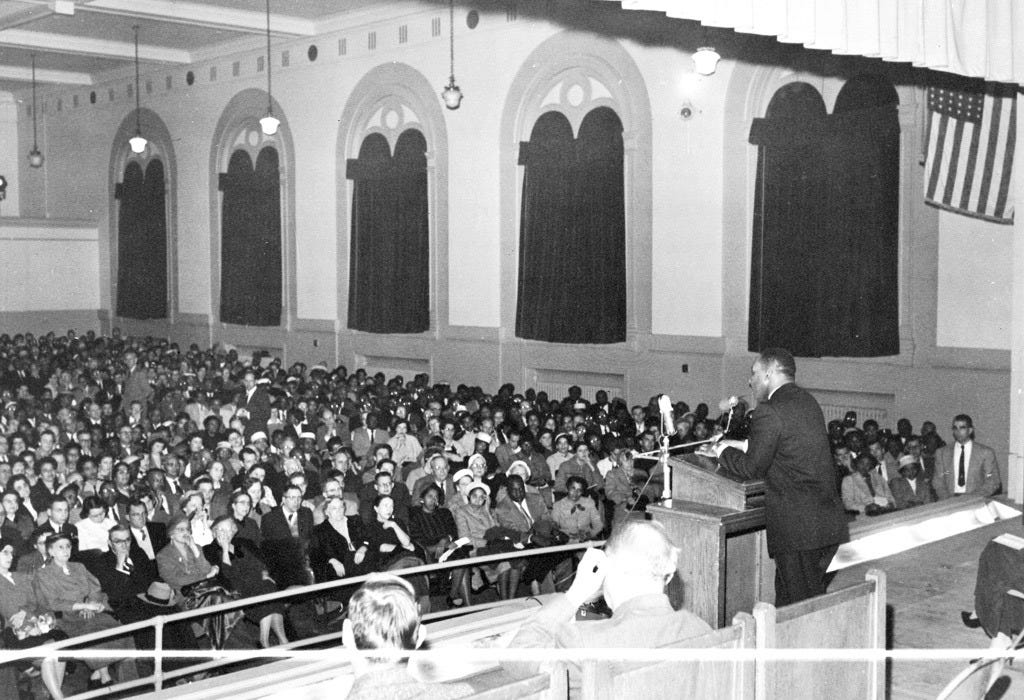
On a cold Monday night in Raleigh, cars lined St. Mary’s Street and edged toward Hillsborough as people moved through the winter dark toward the lit entrance of Needham Broughton High School. The event was taking place within walking distance of N.C State and a short drive from the Capitol dome. This was a school maintained by tax revenue collected from Black and white residents alike yet restricted in 1958 to only white enrollment due to the Jim Crow laws.
So called separate but equal classrooms were closed to Black students whose families helped finance the salaries, the maintenance, the electricity that burned in the auditorium. Broughton High School, which would not admit Black students until 1961, four graduating classes after Brown and three years after King stood on its stage, a delay that illustrates how far municipal practice lagged behind federal law.
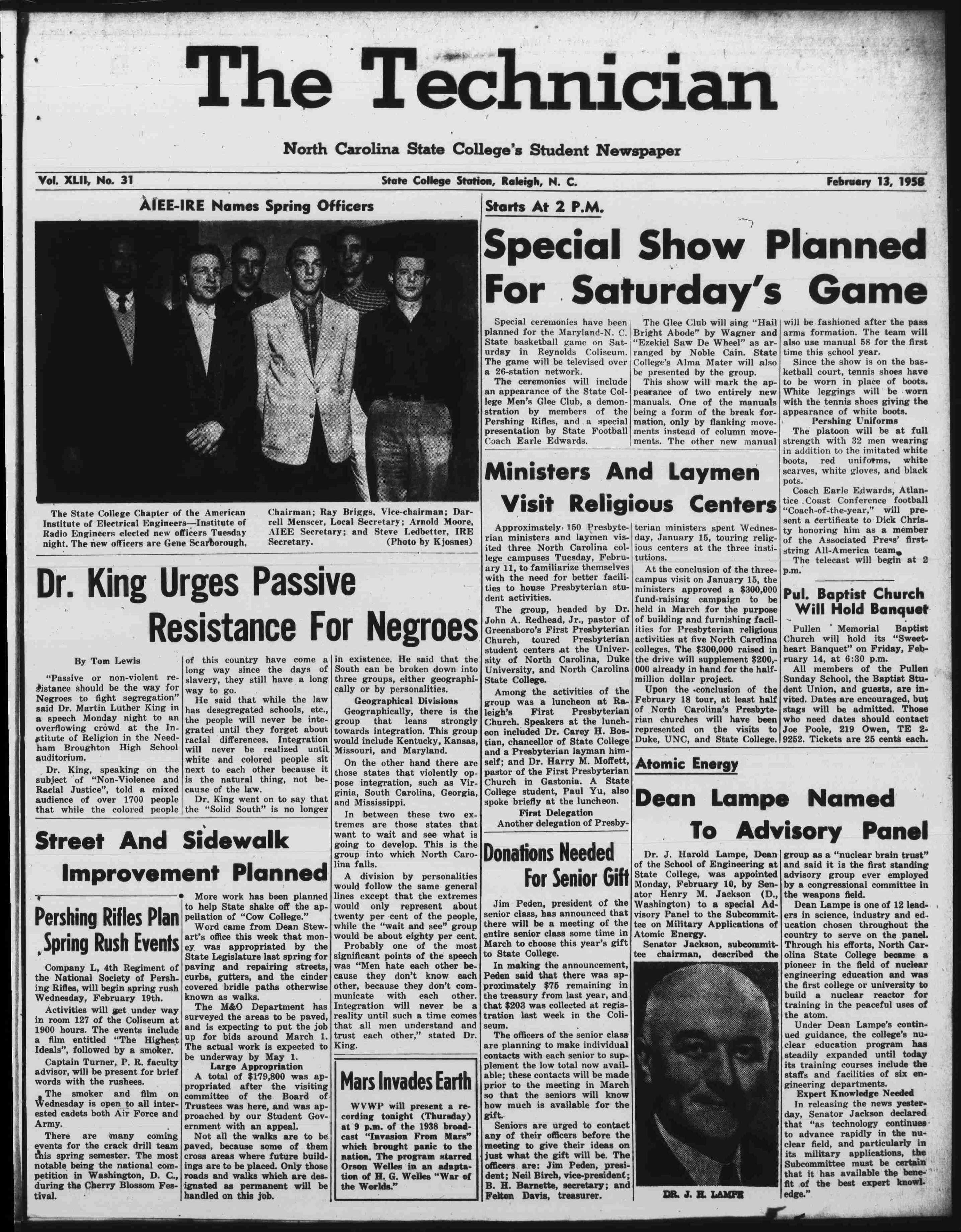
Nonetheless, an interracial audience entered that building to hear a Black minister argue that segregation violated Christian theology and democratic principle. Contemporary reporting, including the February 13, 1958 edition of The Technician, placed attendance at approximately 1,700 and noted that some were turned away.
The Technician’s coverage matters because it records how the address was received within a student press culture that itself existed inside a segregated institution. The reporter highlighted King’s statement that “integration will never be a reality until such a time comes that all men understand and trust each other.” On the printed page the sentence reads as pastoral appeal, yet in a state where school boards were delaying compliance with Brown through procedure and discretion, that appeal implicated admissions policies, zoning decisions, hiring practices, and legislative restraint. Trust, as King framed it, required proximity enforced by law. Understanding required dismantling the barriers that made separation routine governance.
This was at a moment when North Carolina stood formally bound by Brown v. Board of Education yet operationally committed to limiting its consequences through legislative design, most notably the Pearsall Plan enacted in 1956, which vested local school boards with broad authority over student assignment and authorized tuition grants for white families who chose private education rather than integrated classrooms, language drafted in moderation and implemented in a manner that slowed compliance without openly defying the Court.
By early 1958 King was thirty years old and nationally visible. By then he was known well beyond Montgomery because the bus boycott he helped lead had forced the desegregation of that city’s public transit in December 1956 after more than a year of coordinated protest. His home had been bombed in January of that struggle, an attack that signaled how seriously white supremacists regarded the movement. It was during this time that federal authorities led by J. Edgar Hoover’s F.B.I. opened investigative files on him, treating his rise not simply as a pastoral development but as a matter of national security.
The boycott had ended only a year before his visit to Raleigh, and its success had shifted the terrain of conflict from buses to schools, voting rolls, and municipal policy, where compliance with Brown v. Board of Education remained slow and contested.
King’s appearance unfolded amid organized resistance, including resolutions invoking interposition and nullification, legal theories asserting that states could resist federal court mandates, and the steady expansion of White Citizens’ Councils across North Carolina, groups that described themselves as guardians of order while working to prevent integration in schools and neighborhoods.
The event formed part of the Institute of Religion lecture series organized by the United Church of Raleigh, a congregation that would later stand in the lineage of what is now Community United Church of Christ. At the time it was a Protestant congregation. They rented the auditorium for a speech by Dr. King, who by then had already become one of the most scrutinized and polarizing figures in the country. They anticipated an attendance beyond the capacity of its sanctuary. The symbolism did not require interpretation. It was embedded in the floor plan.
Local officials cultivated a reputation for civility and restraint. King’s presence in Raleigh did not erase those structures. It exposed them. An integrated crowd could gather for two hours in a segregated building, applaud a speech on nonviolence and racial justice, and then disperse back into a city still organized by race. The state could tolerate a lecture. It was not yet willing to surrender the architecture of segregation.
That contradiction is the entry point. Raleigh could host King. Raleigh could print his words in a campus newspaper. Raleigh could frame the evening as religious dialogue. What Raleigh could not yet do was integrate the very school whose stage he occupied.
Dr. Martin Luther King Jr. came to Raleigh at the invitation of a church with a documented history, internal minutes, recorded dissent, and a lecture program that had already placed it at odds with white Southern comfort. The United Church of Raleigh brought him as part of its Institute of Religion series, a clergy-organized forum developed in the 1930s to bring nationally known religious voices into the city for public theological and social discussion. His appearance was scheduled months in advance, announced in local channels, budgeted through congregational planning, and promoted beyond the church’s own membership.
The congregation itself did not begin in 1958. Its institutional roots reach back to 1881, when First Christian Church was organized in Raleigh during the rollback years that followed Reconstruction. In 1927, First Christian merged with another congregation to form what became known as the United Church of Raleigh, an act of consolidation that reflected a willingness to move beyond rigid denominational boundaries. By the 1930s the church had established the Institute of Religion as an ongoing public platform, inviting national religious figures and opening its doors to discussions that crossed not only theological lines but racial ones as well.
The archival record indicates that interracial programming was not incidental. It was contested. Interracial religious gatherings in North Carolina during the 1930s did not occur without consequence. Objections were raised within the congregation. Membership departures followed. The majority nevertheless voted to continue the programming. That vote remains in the record. It signals that by the time King was invited in 1958 the church had already navigated internal division over race and had chosen to continue hosting events that pressed against local norms.
When the invitation went to King, the congregation understood the climate. Some framed King as destabilizing and communist. Others described him as necessary and preaching the real gospel of Christ. Inviting him placed the United Church of Raleigh inside a national argument already underway. The church did not position the event as agitation. It placed him within a structured lecture series and described his appearance as theological engagement,
That trajectory continued through later denominational shifts. In 1969, amid the consolidations that formed the United Church of Christ, the United Church of Raleigh merged again, becoming part of what is now Community United Church of Christ. The sequence from 1881 organization, to 1927 merger, to 1930s interracial programming under protest, to the 1958 invitation extended to King, demonstrates institutional continuity rather than improvisation.
King did not arrive in Raleigh through spontaneous activism. He stood on that stage because a white Protestant congregation with an established lecture platform and a record of internal conflict over interracial engagement chose to extend an invitation and to defend it.
By early 1958 the modern Civil Rights Movement was colliding with Jim Crow in places where law and daily governance met. Whether that be in courtrooms, in school board meetings stretched across months of delay, in pulpits where scripture was pressed into service for social order, and in police departments that enforced racial codes with procedural insistence. Legislators invoked order and local control. Open defiance appeared less dramatic than in Arkansas or Alabama, but postponement achieved the same outcome.
Black Raleigh residents walked into a white public institution and the act of entering that auditorium carried weight. Black citizens did not gather casually inside segregated public school facilities. They entered under the authority of a white Protestant congregation that had rented the space for its Institute of Religion lecture series and took seats beneath a roof that barred them during school hours.
King’s remarks in Raleigh echoed arguments he had already placed into print in 1956 in Christian Century under the title “Nonviolence and Racial Justice,” written after the Montgomery Bus Boycott. In that essay he described “a peace that was no peace,” a condition in which outward calm existed while injustice remained intact. “True peace,” he wrote, “is not merely the absence of some negative force, tension, confusion or war; it is the presence of some positive force, justice, good will and brotherhood.”
King told the Raleigh audience that nonviolence confronted injustice directly. It resisted without mirroring brutality. It was “passive physically but strongly active spiritually,” “nonaggressive physically but dynamically aggressive spiritually.” He argued that the struggle must be directed “against forces of evil rather than against persons who are caught in those forces,” distinguishing individuals from the system that trained them to defend inequality. “Privileged groups rarely give up their privileges without strong resistance,” he said to listeners who included students from Shaw University and Saint Augustine’s College, ministers, laborers, domestic workers, and white professionals accustomed to segregation’s protections.
On that same date King recorded remarks for the National Newspaper Publishers Association, the trade organization representing African American-owned newspapers across the country and often described as the Black Press of America. Through that channel he expanded the frame beyond Raleigh, describing the twentieth century as a period in which common people sought social, economic, and political freedom across continents. He referred to the Black press as “one major voice of the conscience of our nation” and stated that “America is not yet America,” linking Southern segregation to a broader unfinished democratic project.
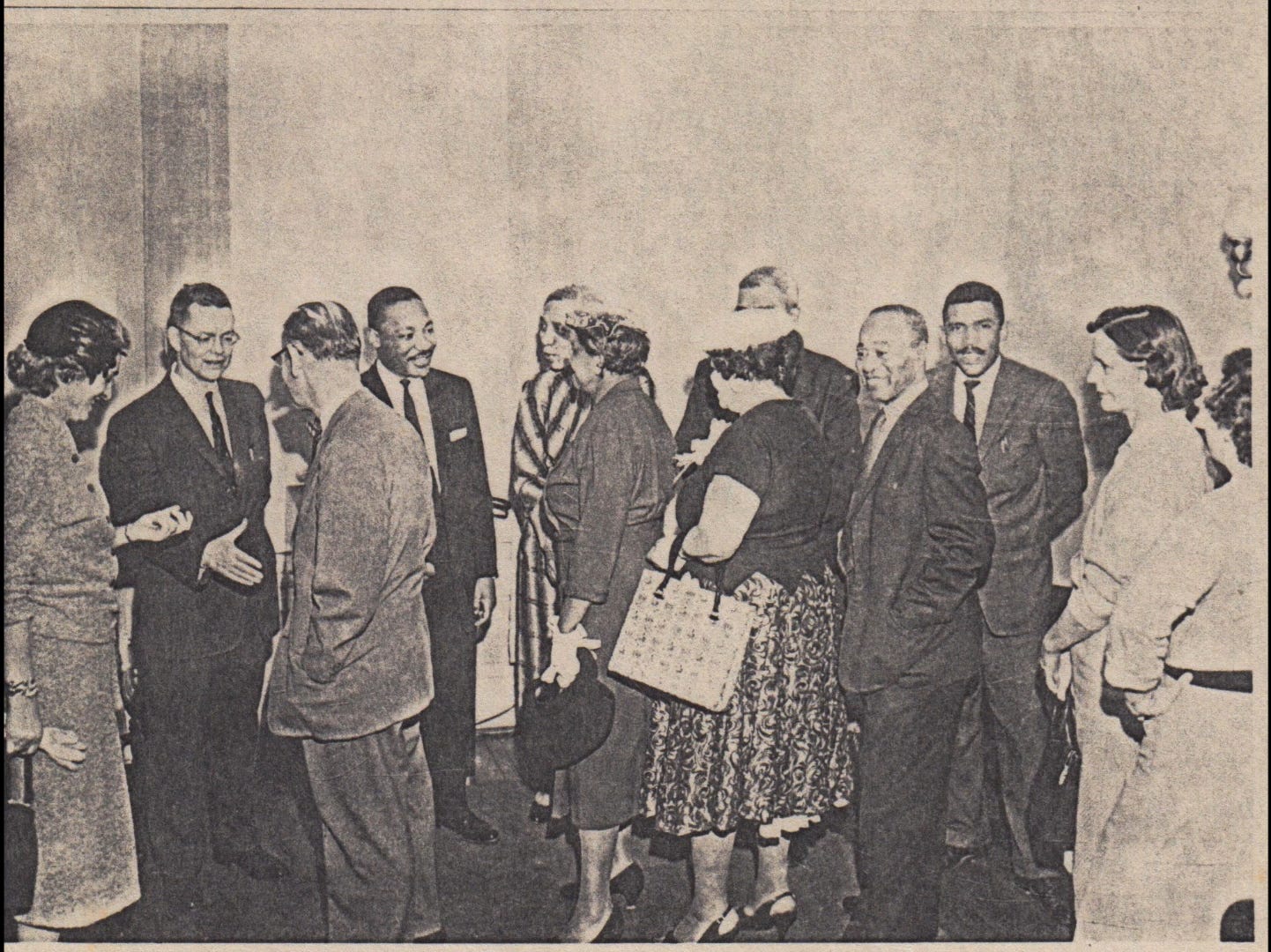
King moved through networks that extended beyond the auditorium. He was typically accompanied during this period by Rev. Ralph David Abernathy, his closest advisor and co-founder of the Southern Christian Leadership Conference. In Raleigh he was hosted by Rev. Samuel Mitchell and Dr. James Cheek, who would later serve as president of Shaw University. His appearance connected local clergy, historically Black colleges, and national civil rights leadership within the same evening.
Opposition organized through institutions rather than spectacle which was typical for the moderate white “Christians” in Raleigh. Local congregations such as Neuse Baptist and Mid-Way Baptist placed advertisements in The News & Observer warning that the “Communist cause is promoted” by King’s presence and predicting disorder. The night before his address, former undercover FBI agent Julia Brown lectured at Memorial Auditorium on alleged communist affiliations. A Raleigh area pastor published an advertisement asking whether King was “Christian or Anti-Christian — Christ or Anti-Christ.” Scriptural language was invoked in defense of segregation.
Now in later decades, institutions that once ran advertisements suggesting he promoted communism now hold commemorative breakfasts, publish retrospective articles, and bless his legacy. That shift does not mean opposition never existed. It reveals how institutions sanitize their own resistance once they think it is safe to claim the legacy.
February 10, 1958 was not a feel good moment of Southern unity. It was an evening balanced between applause and accusation, between integration inside the auditorium and segregation both in and outside its doors, between trust preached from the stage and distrust printed in the morning paper.
In 1958 many white Christians in Raleigh did not honor Martin Luther King Jr. They warned against him. They dismissed his theology as subversion. They questioned whether a minister calling for justice was a threat to order. That was not nostalgia or misunderstanding. It was organized hostility yoked to institutional power, printed in newspapers, preached from pulpits, whispered in civic meetings where moderation meant delay and delay meant preservation of hierarchy.
In 2026 the faces have changed and the microphones are different, yet the pattern is recognizable. Raphael Warnock stands in the United States Senate as a pastor and legislator, speaking about voting rights, health care, economic justice, and the dignity of ordinary people, and he is met not simply with disagreement but with sustained political attack, caricature, and efforts to delegitimize his moral authority.
The backlash to Raphael Warnock appears as perpetual assault in campaign ads and commentary, as insinuation that faith based appeals to justice are partisan manipulation, as efforts to frame dissent as chaos rather than critique and to label structural equity as out-of-bounds conduct.
Stacey Abrams continues to press the country on voting rights and electoral access, insisting that democracy is not a slogan but a system that must function for those historically excluded from it, and she is treated in some corners of political discourse as a villain for naming suppression and organizing against it.
Ayanna Pressley speaks about housing justice and the material conditions that trap families in cycles of displacement and instability, and she is painted as extreme for arguing that shelter is not a luxury but a right shaped by policy. Mondaire Jones presses civil rights oversight and constitutional accountability, reminding institutions that power must answer to law, and he is cast as radical for demanding that oversight be more than ceremonial.
Beyond elected office, Kimberlé Crenshaw, co-founder of the African American Policy Forum, continues to articulate how race, gender, and power intersect in law and policy, warning that civil rights gains are under coordinated rollback under the banner of a supposed war on woke, and she is targeted as a symbol of everything opponents claim is wrong with diversity and equity efforts.
Maya Wiley, leading the Leadership Conference on Civil and Human Rights, speaks plainly about attempts to dismantle voting rights and other hard-won protections, and she too is drawn into a national narrative that treats defense of civil rights as partisan aggression rather than constitutional necessity.
Across the country elected officials and grassroots organizers are disparaged, vilified, and subjected to racial harassment for insisting that democracy function as promised. The attacks do not usually come as mobs outside school doors. They come as legislative proposals narrowing what can be taught, as media narratives that reduce systemic critique to grievance, as rhetorical campaigns that cast structural reform as destabilization.
The method is different from 1958, yet the instinct is familiar. When Black leaders articulate America’s unfinished promise and demand accountability from power, parts of the political establishment recoil, marshal opposition, and attempt to protect old hierarchies rather than confront injustice.
King’s words from that same February 10 recording echo with uncomfortable clarity: “America is not yet America.” In 1958 that line named a nation that tolerated integrated audiences while enforcing segregated classrooms. In 2026 it names a country that celebrates King as a safe icon while resisting the living demands of those who carry forward his insistence that justice must be structural, not symbolic.
The technology has changed, the media environment has multiplied, the party alignments have shifted, yet the core tension remains intact. Those who press the nation toward its professed ideals are still met with suspicion, distortion, and attack from those invested in preserving advantage. History does not erase its resistance. It repackages it. The task remains what it was that night in Raleigh: to see clearly who is calling for justice, who is protecting hierarchy, and what it means to choose between negative peace and the costly work of making democracy real.