

February 8th, 2026
Kenneth Walker III and the Reappearance of the Running Back

The bright California sun sank Sunday night over Levi’s Stadium in Santa Clara on February 8, 2026, as a running back reclaimed the Super Bowl stage in an era that has tried to sideline the position, and in doing so, Kenneth Walker III etched a moment that now threads through North Carolina’s Black sporting history.
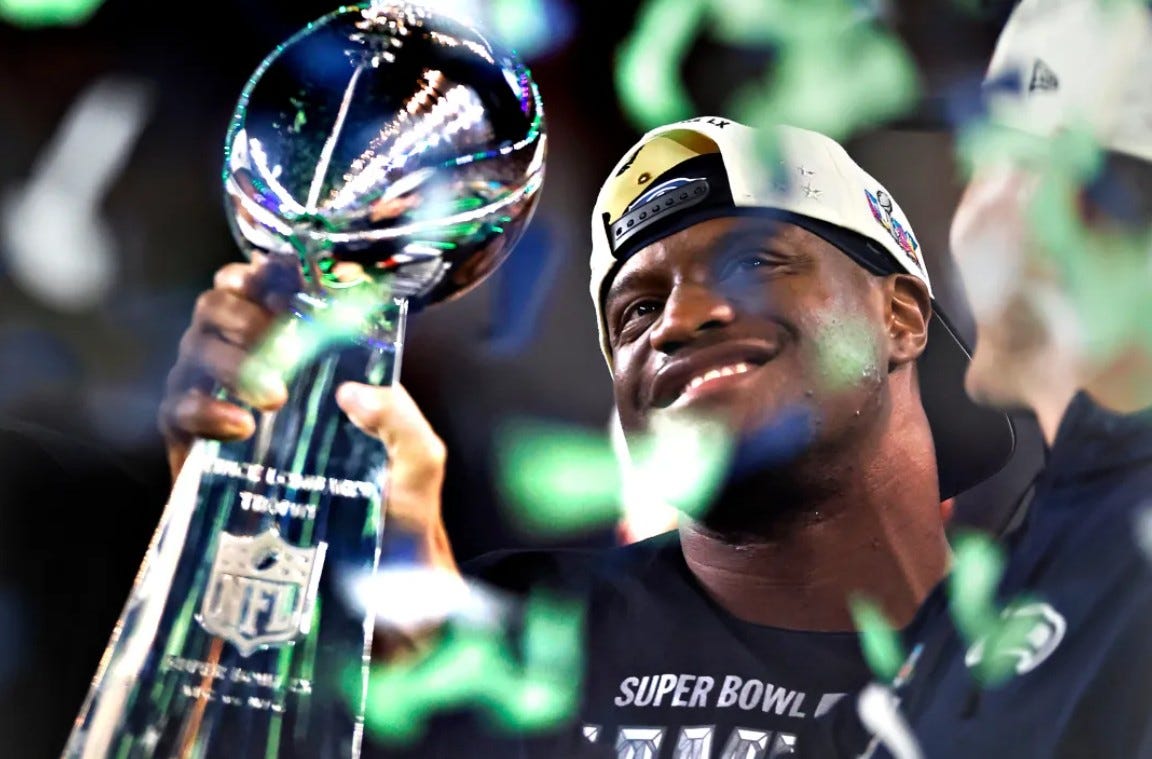
On that date, Kenneth Walker III stamped his legacy with a performance so dominant that he became Super Bowl LX Most Valuable Player, the first running back to earn that honor in a title game since Terrell Davis in 1998, and he did it with a bruising, explosive game that defined his ascension from young under the radar recruit to NFL superstar.
Walker’s NFL climax in 2026 is itself remarkable when considered against the modest beginnings that shaped his path—not just as a football player but as a Black athlete whose brief intersection with North Carolina foreshadowed greatness.
Walker was born on October 20, 2000, in Memphis, Tennessee and raised in Arlington, Tennessee. His parents, Shauntesia Brown and Kenneth Walker Jr., raised him in a largish family where hard work and family pride were central. They sacrificed, pushed, cheered and sometimes scolded to kindle the fire that would carry their son toward the NFL’s brightest stage. His home was not a well known football factory town, not a national recruiting mecca; his ascent was rooted in grit and consistent improvement.
Out of high school, Walker earned attention from college recruiters but not at the level of a blue-chip prodigy. When Wake Forest University in Winston-Salem, North Carolina, came calling in the fall of 2018, it represented something few programs could honestly promise: a real chance to work their way into playing time and grow.
Wake Forest offered him belief when far bigger programs snoozed or overlooked him. The Wake Forest coaching staff sold him on development, patience, and the chance to contribute without getting lost behind a star-studded depth chart. Walker accepted the offer and enrolled with the Demon Deacons in 2019.
At Wake Forest, Walker’s time on the field was short but productive. Across the 2019 and 2020 seasons, he rushed for a combined 1,158 yards and 17 touchdowns in 20 games, showing flashes of the power and speed that would later define his NFL career.
On many Saturday afternoons in North Carolina, crowds saw a compact, powerful runner bouncing off would be tacklers and creating yards with violent intent. He had a streak of multiple touchdown games and big yardage outings that hinted at something greater to come. Yet even as he produced, the offense’s scheme and distribution of carries meant Walker’s role was never the fulcrum it would become later at Michigan State.
That reality helped shape his decision to leave North Carolina. After the 2020 season, Walker entered the transfer portal and elected to play for Michigan State University. At the time, North Carolina coaches and fans saw a talented back leave the ACC for the Big Ten.
For Walker and his advisers, it was a move calculated for exposure and stability as a lead back. Michigan State offered a scheme that allowed the running back to be the focal point, a stark contrast with his role in Winston-Salem. The move paid off instantly, in his first game with the Spartans in 2021, he exploded for 264 rushing yards and four touchdowns. He finished that season with 1,636 rushing yards, earning Walter Camp and Doak Walker Awards as one of the nation’s most dominant rushers.
The Michigan State chapter points to an essential truth in Walker’s narrative. His time in North Carolina was formative but not sufficient on its own to launch him into the spotlight. The state was a stepping stone, a place where his talent was visible but not optimized.
His journey through college football reflects a broader story about Black athletes from smaller markets. Often, they pour themselves into the game, get solid but not spectacular usage, and must make painstaking decisions about where and how they can show the world their full capabilities. This resonates with countless Black players whose talents are shaped by geography, circumstance, coaching philosophies, and structural opportunity gaps.
Walker’s move was vindicated when the Seattle Seahawks selected him in the second round (41st overall) of the 2022 NFL Draft. With that call, the franchise invested in his potential to be more than a rotational back. In his rookie season, Walker delivered. By the closing weeks, he crossed the 1,000-yard mark and made the PFWA All-Rookie Team, earning praise for explosive running and a nose for contact and yards after hit.
In subsequent seasons he continued to prove himself, despite injuries and roster rotation. He led Seattle’s offense in key moments and finished the 2025 regular season with 1,027 rushing yards on 221 carries, ranking among the league’s productive backs. The Seahawks’ coaching staff praised his consistency and explosiveness, and he became foundational to their offensive identity.
The 2025 playoff run provided the crucible. An injury to his backfield mate provided Walker with more touches and more opportunities to carry Seattle’s title hopes. In games such as the Divisional Round against the San Francisco 49ers, he rushed for over 100 yards and multiple touchdowns, blazing a path to the NFC Championship and, eventually, the Super Bowl. In the NFC title game, he again posted over 100 scrimmage yards, helping secure Seattle’s berth to Super Bowl LX.
Then came February 8, 2026. The Seahawks faced the New England Patriots at Levi’s Stadium. In a game gripped by tension and strategic chess matches, Walker took over. He rushed 27 times for 135 yards, with a long of 30, and added 26 receiving yards, combining consistent production with explosive runs. His performance not only helped Seattle to a 29-13 victory but earned him Super Bowl MVP, a feat no running back had achieved in nearly three decades. He was the offensive linchpin in Seattle’s second Super Bowl triumph, leading the way in the game where his play mattered most.
What unfolded on the field that night was not accidental and it was not a fluke. Kenneth Walker III did not stumble into a Super Bowl MVP performance. He dictated the terms of the game and forced New England to live inside them.
Walker finished Super Bowl LX with 135 rushing yards on 27 carries, adding 26 receiving yards for 161 total yards from scrimmage. That 135-yard rushing total does more than anchor the game. It places Kenneth Walker III in rare historical company. Only one running back in Super Bowl history has rushed for more yards in the game itself, Terrell Davis in Super Bowl XXXII, a performance that has stood for nearly three decades as the benchmark for postseason dominance at the position. Walker’s night now sits directly beneath it, not as an echo or imitation, but as the clearest modern reminder that championship football can still be dictated on the ground.
The timing matters. Walker’s performance arrived in a league that has increasingly treated running backs as interchangeable assets rather than offensive foundations. Over the last decade, league-wide trends have pushed toward pass-heavy systems, compressed contracts, and committee backfields that reduce individual workload and long-term security. Against that backdrop, Walker did not merely succeed. He overwhelmed a Super Bowl defense with volume, efficiency, and durability, carrying the ball 27 times without diminishing returns, and closing the game stronger than he opened it.
His Super Bowl performance also capped one of the most productive postseason runs by a running back in recent NFL memory. Across the 2025 playoffs, Walker produced consecutive games of triple-digit scrimmage yardage, sustaining offensive control in situations where mistakes typically decide championships. In the Divisional Round, he crossed the century mark while finding the end zone multiple times. In the NFC Championship Game, he again eclipsed 100 total yards, absorbing pressure and preserving possession against a defense designed to force quick strikes or turnovers. By the time Seattle reached the Super Bowl, Walker was no longer a complementary piece. He was the mechanism.
That postseason consistency reframes his 2025 regular season, which on paper reads as solid rather than sensational. Walker finished the year with 1,027 rushing yards on 221 carries, averaging 4.6 yards per attempt, and added 31 receptions for 282 yards. Those numbers did not dominate headlines. They did something more important. They established reliability. Availability. The capacity to shoulder responsibility without erosion. In a league that often confuses flash with value, Walker quietly accumulated the trust that only shows itself when games compress and options disappear.
By February 8, 2026, that trust had become structural. Seattle’s offense did not lean on Walker because it lacked alternatives. It leaned on him because he had already proven he could absorb contact, manage tempo, and convert uncertainty into control. His Super Bowl performance was not an outlier. It was the logical conclusion of a season and postseason built on repetition, survival, and earned authority.
Seen in that light, Walker’s Super Bowl MVP does more than validate a single night. It challenges the league’s current assumptions about positional value and longevity, particularly as they apply to Black running backs. His performance did not ask for reconsideration. It forced it. On the most visible stage in American sports, Walker demonstrated that durability, volume, and dominance are not relics. They are choices, and they still win championships.
How the yards were produced is what separates the performance from a box score anomaly. Walker did not collect production after the outcome was settled. He took it early and kept taking it. Inside zone runs that should have died at the line turned into eight yards.
First contact became a suggestion rather than a stop. A third quarter run flipped field position and momentum in a single violent acceleration. By the fourth quarter, New England had adjusted alignments, crowded the box, and committed bodies. It did not matter. The outcome stayed the same.
That matters beyond the game because the running back position has been structurally devalued over the last decade, particularly for Black players. Front offices cite analytics to justify committee backfields. Rookie wage scales compress earning windows. Contract extensions vanish after the first deal. Durability is treated as theoretical rather than earned. Walker’s performance did not argue against that logic in abstract terms. It broke it on the most visible stage the league has.
That moment was built game by game over the 2025 season. Walker finished the regular year with 1,027 rushing yards on 221 carries, averaging 4.6 yards per attempt, and added 31 receptions for 282 yards. None of it generated weekly debate shows or MVP buzz.
What it generated instead was dependability. Coaches trusted him in short yardage. Linemen blocked knowing he would press the hole correctly. Play callers stayed balanced because he did not disappear. That kind of trust is not dramatic. It accumulates through repetition and survival.
In the postseason, that accumulation stopped being background and became strategy. When pressure narrowed options and mistakes shortened games, Walker’s presence allowed the offense to stay patient without becoming passive.
Possessions ended in first downs instead of punts. Time stayed on Seattle’s side. By the time the Super Bowl arrived, the performance did not feel like a breakout. It felt like the natural extension of work that had already been validated for months.
February 8, 2026 is now etched in NFL lore as one where the running back position, often overshadowed in the era of aerial dominance, was vindicated. It also intersects, if indirectly, with North Carolina Black history. His connection to North Carolina is not birthed in birth certificate or upbringing, but in the soil of ACC football fields, in the stands at Winston-Salem where a young running back put his first college cleats to work.
It’s a stretch, yes, to tie a Super Bowl MVP night back to North Carolina in Black history, but that stretch highlights something important about the athletic experience. histories are often non-linear, built across space and time, connected by decisions and migrations as much as geography and birthplace.
There is a deeper resonance here for Black history in North Carolina as well. The state has produced a lineage of Black football talent, players whose careers map the shifting currents of college recruiting, NFL opportunity, and larger conversations about race, visibility, and representation. While Walker’s story did not unfold entirely in the Tar Heel State, his early development there shaped the foundation upon which his later achievements rested. When the man who once carried the ball in ACC games now hoists the Super Bowl MVP trophy, North Carolina claims a prideful if partial share in that legacy.
In the end, Walker’s trajectory is more than a football story. It’s a testament to resilience and continual reinvention, a reminder that Black athletic achievement often unfolds across multiple arenas and that meaningful ties in Black history can be found not just in birthplaces, but in moments of growth, transition, and triumph.