

What They Buried Here: North Carolina’s Eugenics Program
How North Carolina built one of the nation’s most aggressive forced sterilization programs and buried the damage for decades.

What They Buried Here is not a nostalgia tour or a safe walk through North Carolina’s past. Every week, I drag one story out from under the polite language and official silence, follow the paper trail, the policy trail, and the damage left behind, because too much of what happened here got buried on purpose and left for regular people to carry in their bodies and their families.
This is not nostalgia or heritage tourism. It will not be some cleaned up version of history for people who want to feel good about the past. This is history with names, consequences, and receipts nailed to the wall.
I. The State Had Filed It Away
In December 2002, the Winston-Salem Journal published a five-part investigation called “Against Their Will,” and North Carolina’s old sterilization program resurfaced from the state’s dark past. The series drew from sealed Eugenics Board records, survivor testimony, and paperwork that makes violence look orderly.
From 1929 to 1974, more than 7,600 people were sterilized: mostly poor, many women and girls, and, under Jim Crow, disproportionately Black. Trapped in public assistance systems, institutions, courtrooms, and under medical authority, they could not fight on equal ground. The story was not lost; it was filed away.
That is what made the Journal’s investigation so hard for Raleigh to dodge. It had signatures and board votes. It had diagnoses and social histories with state-approved language for deciding who should be allowed to have children. It had a whole architecture of harm, built by doctors, welfare officials, state agencies, lawmakers, university people, and civil public servants who knew how to make cruelty sound like administration.
The series forced North Carolina to look at what its own government had done, not over a century ago but deep into the lives of people who were still here, still carrying the damage, still expected to live quietly beside the institutions that had cut them.
North Carolina’s eugenics program was not an accident of bad science or distant history. It was a racist, ableist, gendered system of state power that moved through institutions, punished poor and Black families, and then compensated only a fraction of the people it harmed.
Governor Mike Easley stood up and apologized in April 2003, but only after the Winston-Salem Journal had the digging so loud it could no longer be ignored. He did what governors do when the evidence piles up: called a committee, signed away the last laws that let the state cut people without their say.
The state was trying to get ahead of its own record, after decades of survivors carrying the damage, after every locked file had already done its work, after every dead petitioner and every silenced victim had already been written out of the story. North Carolina called it wrong only when it could no longer keep it hidden.
Fifteen years ago this week, North Carolina finally met in Raleigh to discuss what it owed to those it had already harmed. People were sterilized, sorted, and left to live with the consequences while officials hid behind titles and locked records.
They named it the Governor’s Task Force to Determine the Method of Compensation for Victims of North Carolina’s Eugenics Board, a name so long it seemed designed to bury the crime under syllables. Governor Beverly Perdue signed Executive Order 83 on March 8, 2011. The job was familiar: recommend compensation, review old recommendations, and follow the governor’s direction. Paperwork always follows the wound.
The first meeting took place in Raleigh on Wednesday, April 27, 2011. It was held in a conference room that could have doubled as a crime scene. Dr. Laura Gerald gaveled it in at 10:05 a.m., five minutes late. The state was five minutes late to a meeting about being late by half a century.
After introductions, the panel began talking about compensation, as if a check could ever measure what was taken. The word itself turned forced sterilization into a bureaucratic process, reducing stolen futures and broken families to paperwork.
The April 27 agenda had its own rhythm, and that rhythm is part of the story. Welcome and introductions. Opening remarks. Overview of task force responsibilities. Historical overview of North Carolina’s eugenics program. Demographic victim impact and living victims estimate. Brief discussion, as if what they were discussing was not a state-built program that reached into poor homes, Black families, disabled lives, girls’ bodies, welfare files, hospital wards, and county systems, then called the damage public policy. Closing remarks. Adjournment. If the morning went according to plan, the whole thing would be wrapped up by noon, as if you were scheduling justice between coffee and lunch.
The task force did not mark the beginning of justice. It marked the moment when the state tried to translate bodily theft as administrative procedure, deciding which survivors would be legible enough, documented enough, and alive enough to deserve partial repair.
The North Carolina Justice for Sterilization Victims Foundation put the damage on a county map. Johnston County sits there in the middle of the state, plain as anything, marked 54. The document is titled “Peak of Eugenic Program in North Carolina, July 1946 - June 1968.” It shows the number of sterilizations performed per county during the peak years. Johnston County is surrounded by the same grim regional pattern: Sampson at 56, Harnett at 55, Wilson at 55, Wayne at 85, Wake at 114, Nash at 70, Franklin at 64.
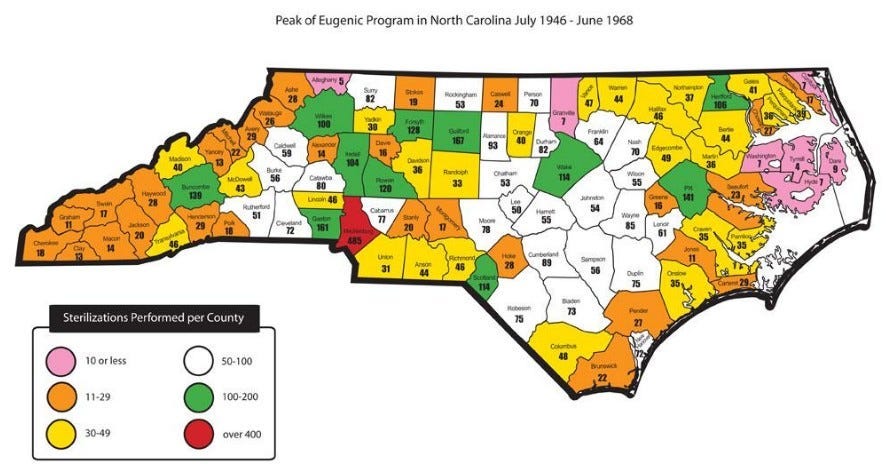
Mecklenburg burns red at 485, the highest in the state, while Tyrrell sits at the other end with 4, and the map’s color key makes the whole thing look almost too simple, like a public-health chart, like something a person could glance at and move past, unless they stop long enough to remember that every number is a person the state decided should not reproduce.
By March 19, 2012, almost a year after that first task force meeting, the compensation record had narrowed Johnston County down to one verified victim. One person from Johnston County verified in the chart as of that date.
Fifty-four when the state was counting sterilizations. One when the state was verifying victims for compensation. I could not find whether the Johnston County survivor in the online record actually got paid. The records have no named petitioner, no named doctor, no race or gender breakdown for the 54, no ages, no diagnoses, no trail from county resident to state order to operating room.
Anyone who’s stood on the wrong side of an office counter knows that trick: the form is clear when the county wants proof and signatures, but the answers vanish when accountability is reversed. April 27, 2011, was not redemption. It was North Carolina arriving late to its own wreckage, with binders instead of answers, after violence had been sealed in records and names hidden in archived files.
II. Before the Knife, There Was the Measuring Stick
The knife did not come first. First came the lesson: that some bodies could be measured, ranked, corrected, and improved by people with the authority to call their judgment science. Before North Carolina built the board that would approve sterilizations, before county welfare offices helped push people into a state process that treated reproduction like a public problem to be managed, before Johnston County appeared on a peak-period sterilization map with 54 printed inside its borders, the local paper in Smithfield was already carrying the softer face of the same old sickness.
It contained prizes, doctors, mothers, and State Fair language. The paper did not need to say ‘sterilization’ yet, because it was still teaching people to believe that human worth could be measured by experts scoring on a card, ranked publicly, corrected through instruction, and improved like livestock.
The headline ran across the top of the page in a thick black box: “BETTER BABIES HEALTH CONTEST.” Friday, October 17, 1913, page five of The Smithfield Herald, a Johnston County newspaper, and there under the headline was a little drawing of a baby stretched out on a table for weighing. Then another drawing lower on the page showing a child’s body marked for measurements, head circumference, chest circumference, abdomen circumference, leg length, the body turned into an object of inspection, the baby made into a diagram before anybody in Johnston County reading that paper would have been asked to think of that as a warning.
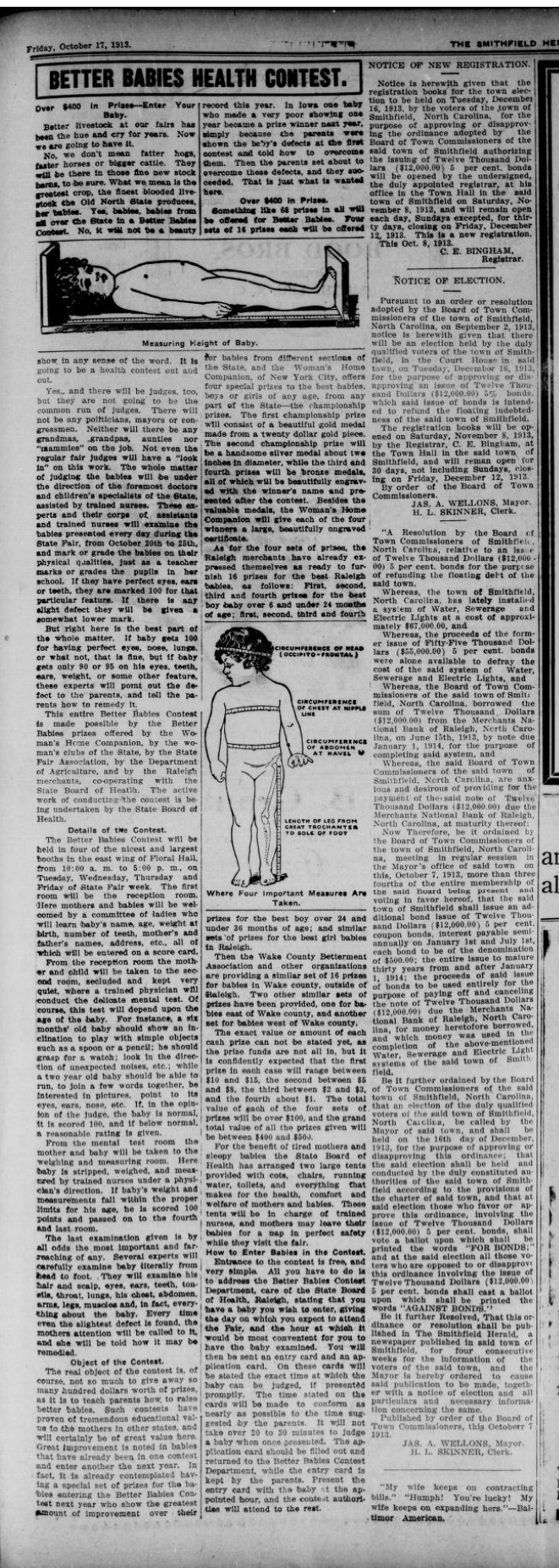
The article opened with a comparison that ought to make the page feel colder than it looks: “Better livestock at our fairs has been the hue and cry for years,” then moved from hogs and horses and cows into children, calling babies “the greatest crop, the finest blooded live stock the Old North State produces,” and there it was, in print, in Smithfield, more than a decade before North Carolina created the Eugenics Board, the old promise that the human future could be improved if the right people measured the right bodies and told everybody else what counted as defect.
The article said this would “not be a beauty contest.” It said trained nurses and “foremost doctors and children’s specialists” would judge babies by physical qualities, and that if a baby scored low on height, weight, eye color, teeth, or some other feature, the experts would point out the “defect” to the parents and tell the parents how to remedy it.
The contest was not presented as fringe science or a crank spectacle. The Herald said the Better Babies Contest was made possible by the Woman’s Home Companion, the women’s clubs of the state, the State Fair Association, the Department of Agriculture, Raleigh merchants, and the North Carolina State Board of Health, with “the active work of conducting the contest” undertaken by the State Board of Health.
That list is its own little indictment, if you read it without flinching. People with titles, tables, booths, and forms. The kind of people who could make human grading look like service, because the paper called it health, the doctor called it science, and the fair made it festive.
It did not always begin with a law. Sometimes it began with a booth at a fair, a nurse with a measuring tape, a scorecard, a mother being told her baby had a correctable defect, a newspaper explaining that babies from different sections of the state would compete for a championship prize, and “mental test” language embedded inside a paragraph that otherwise sounded like a child health clinic.
The Smithfield Herald described the “delicate mental test” for babies over a month old, with simple objects like a spoon, pencil, household appliance, watch, or noise maker used to judge attention, hearing, sight, and responsiveness, and the article treated that little performance of judgment as normal because the whole page had already taught the reader that normal meant being examined by someone with more authority than you.
NCpedia’s broader history of Better Baby contests helps put the Smithfield page where it belongs. Woman’s Home Companion developed the Better Babies Standard Score Card with physicians, distributed pamphlets on how to run contests, and built the contests around physical and psychological measurements, including height, weight, symmetry, skin, bones, head length, ears, lips, forehead, nose, disposition, energy, expression, and attention.
Doctors made the contest seem reputable. They helped make a baby contest feel like an objective measurement instead of a public ranking, helped make eugenics-adjacent thinking feel like modern care, and helped give the old American hunger for better blood a white coat and a clipboard. Eugenics did not become dangerous only when it became surgery. It was already dangerous when it trained ordinary readers to see inequality as a defect, poverty as heredity, and expert judgment as neutral.
The 1913 Smithfield Herald article states that the Better Babies Contest was conducted by the North Carolina State Board of Health. Twenty years later, when North Carolina created the Eugenics Board in 1933, the secretary of the State Board of Health held one of the five seats on that board. The same state public health apparatus that helped make baby grading seem like real science in the fairground world of 1913 later had formal authority inside the state sterilization review system.
The 1913 Smithfield page had graded babies for defects under the language of public health. By 1949, the same logic had hardened: the state’s problem was no longer only which children measured up, but which children should be born at all.
III. The Welfare Office Was the Door
North Carolina did not leap from baby contests to surgery in one clean motion. The state passed an early sterilization law in 1919, then a 1929 law that allowed the sterilization of people the state labeled “mentally defective” or “feeble-minded,” including people inside public institutions, with county boards also given authority to order sterilization at public expense in certain cases after petitions from family or guardians.
The 1929 law did not survive because the appeal process was missing, not because North Carolina had suddenly decided forced sterilization was wrong. Four years later, the General Assembly came back with a cleaner version, created the Eugenics Board, added the appeal language the court said was missing, and kept the state pointed in the same direction.
For poor families, and especially for Black women and girls, welfare was not only a place to ask for help. It was also a place where the state gathered information, made judgments, and converted need into surveillance.
In 1933, the board’s membership tells you exactly what kind of power was sitting in the room. The Commissioner of Public Welfare. The Secretary of the State Board of Health. The chief medical officer of Dorothea Dix Hospital. The chief medical officer of a rotating state mental institution outside Raleigh. The Attorney General.
That is not meant to be a civics lesson. The board had welfare beside health beside medicine beside law, ready to decide who could be sterilized with the calm authority of people whose own families were not the ones being measured, labeled, petitioned against, or cut. Eugenics depended on a class of decision-makers who could mistake their own safety for objectivity and another family’s vulnerability for evidence.
The legal structure had its own ritual. A petition came forward. A medical history came with it. A social history came with it, too, which is one of those phrases that sounds harmless until you remember what kind of people get their lives turned into a “social history” by somebody with power over food assistance, institutional placement, school judgment, family reputation, and the threat of being marked unfit.
In institutional cases, the institution’s executive head or representative presented the case. In cases involving people outside institutions, the county superintendent of welfare or another authorized county official presented the case, with records addressing whether the person was likely to produce children.
North Carolina embedded the danger inside public welfare. The Department of Public Welfare became part of the delivery system, and the state’s own historical summary states that the Eugenics Board program operated within the former Department of Public Welfare, with petitions considered by the same five-member panel of state officials mentioned before.
North Carolina also gave social workers a power no other state gave them in the same way: the ability to petition for sterilization of members of the public, people who were not already locked inside state institutions, people living in counties, families, neighborhoods, and ordinary rural places where a visit from welfare could already feel like the state standing on the porch.
IV. The Program Got Worse After the World Saw Where Eugenics Led
North Carolina’s postwar sterilization campaign exposes the lie that eugenics simply belonged to an earlier, less enlightened age. After World War II, eugenics should have been too radioactive for any state to keep selling it as a public good. American eugenics had helped feed the same logic Nazi Germany carried into extermination, and after the war, a lot of states backed away from the word, the theory, or at least the open practice.
The state’s own Department of Administration says more than 70 percent of North Carolina’s sterilization victims were sterilized after 1945, while other states had conducted most of their sterilizations before World War II. After the world had seen where eugenic logic could lead when a government decided some people were unfit to exist, North Carolina kept the process moving and then pushed it further through welfare, health, medicine, county authority, and public respectability.
During that time, the welfare system was also growing, the public health bureaucracy spread, and more poor families, especially women and girls, found themselves face-to-face with state power. In the late 1940s, the Department of Public Welfare promoted sterilizations as solutions to poverty and illegitimacy, selling them as science and progress. The targets were now in towns and neighborhoods, where a welfare visit could trigger a petition and diagnosis, with social workers as the pipeline.
The Human Betterment League of North Carolina was part of that respectability and coercion. Founded in 1947, the League gave sterilization propaganda the voice of civic improvement, medical concern, and elite common sense.
James G. Hanes brought Winston-Salem business power. Clarence Gamble brought physician status and the Procter and Gamble fortune. C. Nash Herndon brought genetics authority from the Bowman Gray School of Medicine. A. M. Jordan brought psychology and UNC respectability. Elsie Wulkop and others tied the League to the state’s professional and civic world. This was not backwoods ignorance; it was the elite of North Carolina.
In 1947, the Cherokee Scout reported that the League had launched an educational campaign for stronger enforcement of North Carolina’s sterilization law and mailed more than 40,000 pamphlets. By 1949, a Human Betterment League advertisement in The Daily Tar Heel was selling “Selective Sterilization” as protection, warning that children should not be born to “insane or feebleminded” parents and urging civic, medical, religious, educational, and public-health leaders to treat sterilization as a mental-health measure.
The language family is easy to recognize once you have seen the 1913 Smithfield Herald page. In 1913, the public-health world measured babies for “defects” under the smile of the State Fair, doctors, nurses, women’s clubs, agriculture, merchants, and the State Board of Health. By 1949, that same belief had hardened into sterilization propaganda. The question was no longer only which children measured up, but which children should be born at all.
Propaganda works best when it is dressed as science, placed in front of ministers, doctors, teachers, civic leaders, and public-health workers who already knew how to call poor people a problem without saying they hated them.
North Carolina’s danger wasn’t a single law or board. The state built a legal structure, involved county welfare offices, surrounded it with medical authority, and allowed elite propaganda to frame it as mercy and prevention. The state spent years teaching the public that experts could judge bodies, families, and futures in the name of improvement.
V. The Black Press Had Already Named the Abuse
North Carolina didn’t need the 2002 investigation, a governor’s apology, or official language about victims to know this was abuse. The reality was visible long before.
On July 21, 1973, The Carolina Times, a Black newspaper out of Durham with the motto “The Truth Unbridled,” ran an editorial on page 2A under the headline “Abuse of Sterilization Authority,” and the headline alone cuts through decades of white institutional racism.
The difference was not that Black communities failed to see the violence. The difference was that white institutions controlled which warnings became official knowledge.
The Carolina Times was not writing from the safe distance of 2002 or the official apology years, this was 1973, with the program active and people still living with the consequences.
The Carolina Times was looking at sterilization as it touched welfare aid, poverty, race, and official judgment, and the paper did not need a task force to know abuse when it saw it.
The editorial, named “a flagrant abuse of sterilization authority,” tied the danger to Alabama and North Carolina, pointed toward decisions determined by welfare aid and moral judgments from people in power, named racist policies harming Black people and the poor, and warned that sterilization should never become a condition for welfare aid or help for a low-income family.
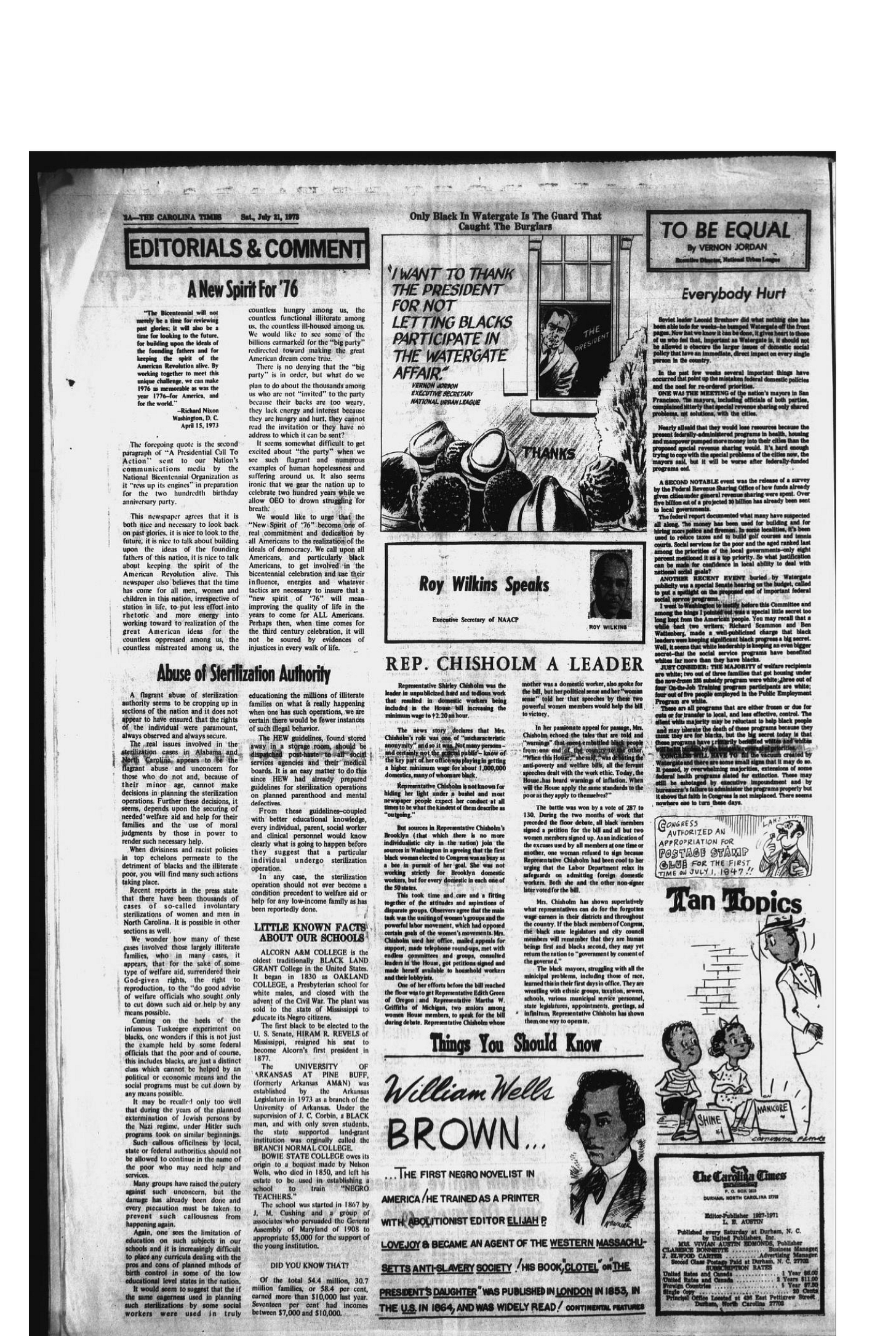
The Carolina Times did not have the power to open the state’s locked files. It did not have the power to make the Eugenics Board answer in public for every petition, every social history, every board vote, every doctor’s order, every welfare threat dressed up as concern.
The paper had something else, which may be why the record still feels so sharp fifty years later. It used plain language to describe the power relationship. Poor people and Black people were being made vulnerable by the same systems they had to approach for help, and it still wasn’t until nearly 40 years later that the state pretended to offer any type of reparations for its crimes.
VI. Elaine Riddick and the Lie of Consent
On March 5, 1968, North Carolina sterilized Elaine Riddick.
She was a 14-year-old from Winfall in Perquimans County, and had just given birth to a son after being raped by a 20-year-old man who had a history of assault and incarceration. She had not told anyone about the rapes because he threatened to kill her. The state did not look at that child and see a child who had been hunted, threatened, impregnated, and left to survive the grown man who hurt her. The state looked at her pregnancy and built a case against her.
That is how the file worked. A Perquimans County social worker concluded Elaine Riddick was promiscuous and feebleminded, drew up a petition for eugenic sterilization, and the official language did what official language always does when power wants the wound to disappear.
It shifted blame from the perpetrator to the survivor. Rape became evidence of bad character, poverty a defect, fear a liability. This was not a misinterpretation. It was a racist and sexist system turning conditions imposed on a Black girl into proof against her.
The consent story is its own kind of rot. Sources differ on which family member signed, with one account saying her father signed, even though he no longer had custody, and others saying her grandmother, who could not read, signed with an X after being told the procedure was necessary to help the girl.
The state treated that signature as consent, even though Elaine Riddick did not understand what was happening and her guardian could not protect her from what officials had already decided.
She did not learn the truth until years later, when a doctor told her she could never have more children. Riddick said the doctor used the word “butchered.” That word tears through every polished phrase the state ever used: eugenics, welfare, public good, consent. They all get smaller when a woman is told she was butchered by a state that called her defective as a child.
Riddick fought back and sued North Carolina for $1 million, and the United States Supreme Court declined to hear the case. She also gave the state the sentence it deserved when she answered the old file’s judgment of her character: “I couldn’t get along well with others because I was hungry. I was cold. I was a victim of rape.”
That is what a “social history” could do: turn hunger, cold, poverty, and fear into reasons to blame the victim, making a child answer for conditions adults and institutions failed to change. It turned survival into a diagnosis.
In 2011, while North Carolina was holding public hearings about compensation, Riddick said it even more straightforwardly: “I have to get out what the state of North Carolina did to me. They cut me open like I was a hog.”
That sentence reaches back to the 1913 Smithfield Herald page, where babies were compared to “the finest blooded livestock the Old North State produces,” and it reaches forward into every state document that tried to make forced sterilization look like a decision made by proper authorities for proper reasons. Riddick and the others drag the reader back to the body, which is where the state always hoped the paperwork would not have to go.
Riddick’s voice was not alone in those hearings. Other survivors also came forward to share what had been done to them.
Survivors included Nial Ruth Cox, sterilized at 18 after seeking help from the welfare system in Wake County, and Willis Lynch, sterilized as a teenager at a state training school.
Each story was different, but the pain echoed. Some described betrayal by doctors and caseworkers, others spoke of lost futures, shame, and years of silence. Riddick’s testimony helped break that silence, joining other survivors who were finally able to say publicly what the state had done.
VII. A Number Is Not Justice
North Carolina eventually put money on the table, though even that sentence gives the state too much dignity. In 2013, the General Assembly set aside $10 million for the Eugenics Sterilization Compensation Reserve, with the Industrial Commission handling eligibility and the Department of Administration’s Office of Justice for Sterilization Victims helping with claims.
The claim deadline was June 30, 2014, and the state’s preserved claims page states that a claimant had to have been alive on June 30, 2013, to qualify. Which means dead victims did not get made whole. Families who carried the silence after a mother, aunt, sister, brother, cousin, or child died did not suddenly get the state’s door opened wide. The state built a claims process with a small opening, then acted as if anyone left outside had simply failed to come forward.
The task force said $50,000 was the number for a living victim, and they guessed there might be 1,500 or 2,000 people still alive to claim it. The state did not find 2,000, or even 1,500. The Industrial Commission certified 220.
The last checks went out in 2018, after years of forms, deadlines, appeals, and the kind of paperwork that always seems to run smoother when the state is taking something than when it is paying it back.
The payments came in pieces: first $20,000, then $15,000, and a final payment of just under $10,500. It was money, but it was not justice. It was not even close; it was the state trying to buy silence after the damage was already done.
There is too much to cover because this story is uglier than a simple list of villains. North Carolina did not need one monster in one office. It built the program out of welfare, health, law, medicine, universities, newspapers, philanthropy, women’s clubs, fairs, scorecards, pamphlets, and silence.
The story is a county number in a state table, real people hidden behind sealed records and bureaucracy, a baby contest in a Smithfield paper, a sterilization map, a Black newspaper naming abuse the state wouldn’t acknowledge.
North Carolina wanted this history filed down into something a clerk could close, a board name, a petition file, a county chart, a task force agenda, an eligibility deadline, a check mailed too late to too few people, a dead office page left online so the state could point at the archive and act like the thing had been handled. It was not handled.
A state cannot repair violence against its people while it still keeps the records sealed, the eligibility narrow, the victims unnamed, and county numbers without faces.
An estimated 7,600 people were sterilized under North Carolina’s authority. Only 220 were certified for compensation. North Carolina compensated roughly 2.9 percent of the people it sterilized, meaning more than 97 percent were left outside the state’s repair process. The state found people just fine when it wanted control over their bodies. When the question became repair, it somehow found only a fraction of them.
The others are still there, under sealed files, under county numbers, under family silence that never belonged to the family, under old welfare language and medical signatures and the rotten mercy of men who turned somebody else’s future into paperwork.
North Carolina should not be allowed to leave them there. The number is not the end of the story. The number is the grave marker, the locked drawer, the county line, the first shovel cut into the dirt.
Primary state records and official documents
NC Department of Administration, Office of Justice for Sterilization Victims, “About the Program”
NC Department of Administration, Governor’s Task Force Final Report, January 27, 2012
NC Department of Administration, Governor’s Task Force April 27, 2011 Agenda
NC Department of Administration, Governor’s Task Force Preliminary Report, August 1, 2011
Johnston County and newspaper records
DigitalNC Primary Source Set, “The Eugenics Movement in North Carolina”
DigitalNC, The Carolina Times newspaper information page
Library of Congress, The Carolina Times title record
Better Babies and eugenics culture
NCpedia, “Better Baby Contests”
NCpedia, “Eugenics in North Carolina”
Human Betterment League and propaganda
North Carolina History Project, “Human Betterment League of North Carolina”
North Carolina History Project, “Eugenics Board”
I linked as much as I could inside the article itself, but there was no way to fit every source, report, newspaper scan, survivor interview, archive page, and follow-up thread into one piece without exceeding the limit allowed to share via email.
I’m putting the rest here for anyone who wants to keep digging into this buried part of North Carolina history.
Some of these sources are survivor testimony. Some are broader research tools. Read them with care, especially the survivor stories, these were people’s bodies, families, children, and futures.
Survivor testimony and reporting
NPR, “N.C. Considers Paying Forced Sterilization Victims,” June 22, 2011
https://www.npr.org/2011/06/22/137347548/n-c-considers-paying-forced-sterilization-victims
NPR, “A Brutal Chapter in North Carolina’s Eugenics Past,” December 28, 2011
https://www.npr.org/2011/12/28/144375339/a-brutal-chapter-in-north-carolinas-eugenics-past
Rutgers research record, “Reassessing Eugenic Sterilization: The Case of North Carolina”
https://www.researchwithrutgers.com/en/publications/reassessing-eugenic-sterilization-the-case-of-north-carolina/
University of Illinois, “Behind the Board: Eugenic Sterilizations in North Carolina,” June 5, 2020
https://lls.illinois.edu/news/2020-06-05/behind-board-eugenic-sterilizations-north-carolina
BWWLA, “Victims Speak Out About North Carolina Sterilization Program Which Targeted Women, Young Girls and Blacks”
https://bwwla.org/victims-speak-out-about-north-carolina-sterilization-program-which-targeted-women-young-girls-and-blacks/
WUNC, “Why Some NC Sterilization Victims Won’t Get Share of $10 Million Fund,” October 6, 2014
https://www.wunc.org/law/2014-10-06/why-some-nc-sterilization-victims-wont-get-share-of-10-million-fund
JournalNow, “N.C. Eugenics Victims Projected to Get Final State Compensation Payment Soon”
https://journalnow.com/news/local/n-c-eugenics-victims-projected-to-get-final-state-compensation-payment-soon/article_87e3c891-7828-5f2d-856f-498b6405781a.html
JournalNow, “Wake Forest Examines Eugenics Here and Abroad”
https://journalnow.com/news/local/wake-forest-examines-eugenics-here-and-abroad/article_4d716cbc-9bfc-11e2-b770-0019bb30f31a.html
Broader data, archive, and research tools
University of Vermont Eugenics Archive, North Carolina overview
https://www.uvm.edu/~lkaelber/eugenics/NC/NC.html
University of Vermont Eugenics Archive, North Carolina older overview page
https://www.uvm.edu/~lkaelber/eugenics/NC/NCold.html
NC Digital Collections search page
https://digital.ncdcr.gov/
DigitalNC North Carolina Newspapers search
https://newspapers.digitalnc.org/
State Archives of North Carolina
https://archives.ncdcr.gov/
Johnston County Heritage Center
https://www.johnstonnc.gov/heritage/
Johnston County Heritage Center census page
https://www.johnstonnc.gov/heritage/hccontent.cfm?PID=census
Reporting series and secondary context
Carolina Public Press, “Data Shows Buncombe’s Role in NC Sterilization Program; Number of WNC Sterilizations”
https://carolinapublicpress.org/4373/data-shows-buncombes-role-in-nc-sterilization-program-number-of-wnc-sterilizations/
WECT, “NC Justice for Sterilization Victims Foundation Confirms 100 Victims”
https://www.wect.com/story/17194112/nc-justice-for-sterilization-victims-foundation-confirms-100-victims/
KVPR/NPR archive, “North Carolina Eugenics”
https://www.kvpr.org/2002-12-14/north-carolina-eugenics
Lozier Institute, “Victims of NC Eugenics Program to Receive Compensation at Last”
https://lozierinstitute.org/victims-of-nc-eugenics-program-to-receive-compensation-at-last/
Lozier Institute, “North Carolina Eugenics Victims Still Seeking Justice Due to Compensation Technicality”
https://lozierinstitute.org/north-carolina-eugenics-victims-still-seeking-justice-due-to-compensation-technicality/
It was fascism then and it's fascism now as the current administration demonizes foreigners, minorities and political adversaries alike. From Dear Leader on down to RFK Jr, Stephen Miller, Hedgseth to billionaire like Peter Thiel and Palantir CEO Alex Karp they all regard anyone not one of their elite ingroup as unworthy and subject to some sort of rendition, deportation, imprisonment or euthanasia by ICE or neglect in detention.